
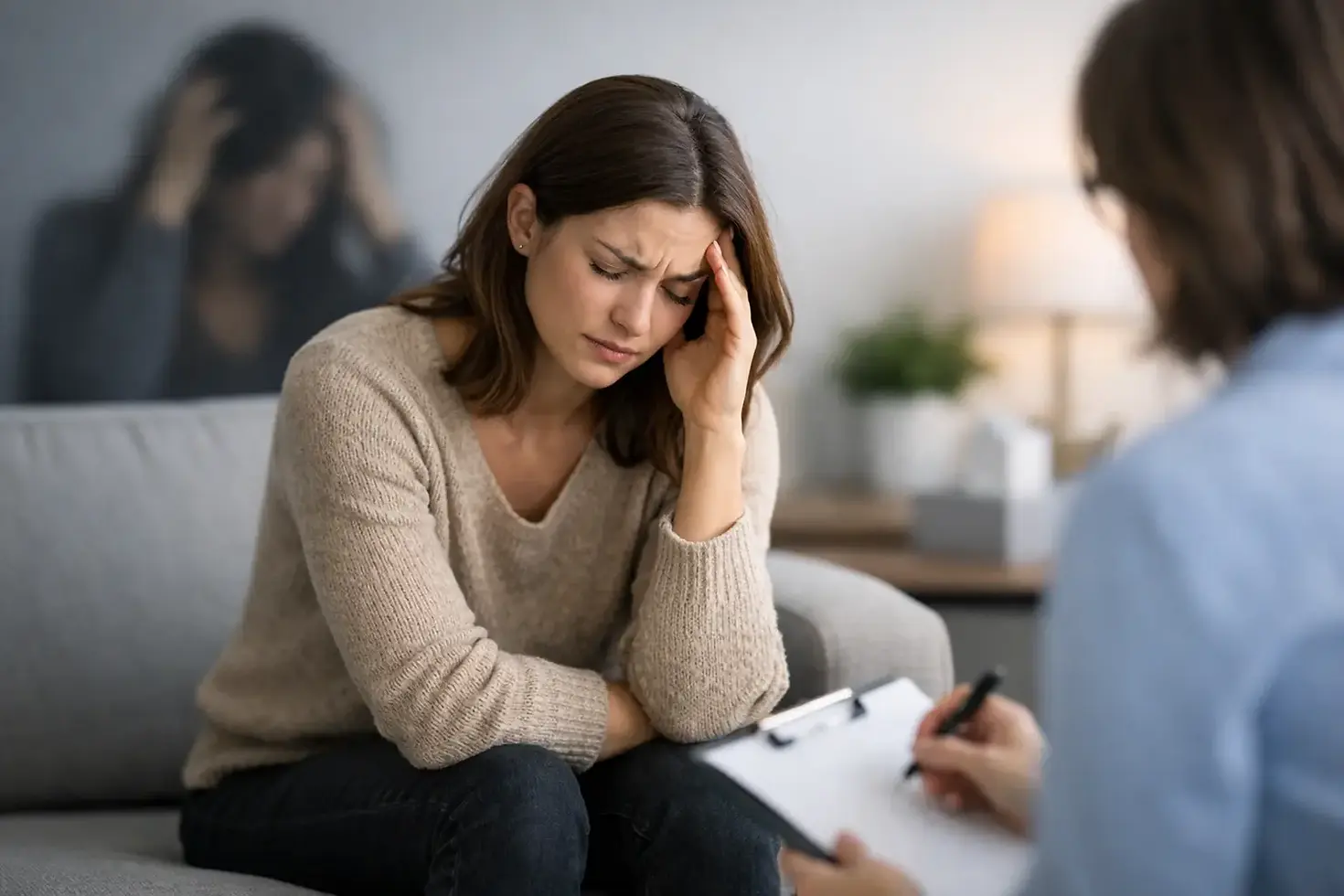
Anxiety and Relationships: How Worry Affects the People Around You

Anxiety is often described as a personal experience. Something happening inside one person's head.
But anxiety doesn't stay inside one head. It moves through relationships. It shapes conversations, patterns of closeness and distance, the way you ask for reassurance, the way you avoid conflict, the way you need things to be certain when certainty isn't available.
If you live with anxiety — or love someone who does — this probably sounds familiar.
How Anxiety Affects Relationships
Anxiety changes how you interact with the people around you. Not usually deliberately. But consistently.
Some of the most common ways include:
Seeking reassurance. When anxiety is running, the mind looks for certainty. People close to you become a source of it: "Are we okay?" "Do you think that went badly?" In the short term, reassurance helps. But over time, it can become exhausting for both people — because the relief never lasts, and the questions keep coming.
Avoiding conflict. Many anxious people are highly sensitive to the feeling that someone is upset with them. So they avoid conflict at all costs — saying yes when they mean no, not raising genuine concerns, absorbing tension rather than naming it.
Over-controlling. Anxiety often produces a strong need to manage uncertainty. In a relationship, that can look like needing to plan everything in advance, struggling when plans change, or trying to manage a partner's behaviour or decisions to feel safe.
Withdrawing. When anxiety is high, it can make social interaction feel draining or unsafe. Anxious people sometimes pull away — becoming less engaged, less present, more distracted by the internal noise. Partners can experience this as coldness or rejection, when what's actually happening is overwhelm.
Jealousy and relationship anxiety. For some people, anxiety focuses specifically on the relationship itself: a persistent fear of abandonment, of a partner leaving, of not being enough.
What Partners and Family Members Experience
Living with someone who has anxiety — or loving them — is genuinely hard. It often produces its own set of emotional challenges.
The reassurance cycle is one. Providing constant reassurance is tiring, and it doesn't work. Partners can start to feel like their own needs are secondary — that they're managing the anxious person's experience rather than being in a reciprocal relationship.
There can also be resentment. Unspoken, often. Because the anxiety has shaped what the couple or family can do — plans cancelled, situations avoided, decisions made around managing the anxiety rather than around what everyone actually wants.
None of that means the relationship is broken. It means it's under pressure — and probably needs some attention.
When Anxiety Becomes Relationship Anxiety
Some people experience what's sometimes called relationship anxiety: a specific, persistent fear about the relationship itself. This can look like:
Constantly questioning whether you're in the right relationship. Seeking repeated reassurance that your partner loves you. Catastrophising small arguments into evidence that everything is falling apart. A fear that you'll be abandoned. Obsessing over whether your feelings are "real."
Relationship anxiety is particularly difficult because it can produce exactly the behaviours — the repeated questioning, the neediness, the testing — that put the most pressure on the relationship.
And What About Attachment?
Many patterns of relationship anxiety connect to attachment: the internal working models of relationship that we develop in childhood, based on how our earliest caregivers responded to us.
People who grew up with inconsistent caregiving often develop an anxious attachment style. They're hypervigilant to signs of rejection or abandonment. They need more reassurance than their partner can easily provide. They find it hard to trust that the relationship is stable, even when it demonstrably is.
Understanding this doesn't make the behaviour someone else's fault. But it does make it more understandable — and more workable.
How Counselling Helps
Counselling can help with anxiety in relationships in two ways: individually and together.
Individual counselling gives you space to understand how your anxiety is affecting the relationship — the patterns you've developed, where they came from, and what a different way of relating might look and feel like.
Couples counselling gives both people a space to understand the dynamic they're in — and to shift it. It's not about blame. It's about understanding how two people's patterns are interacting, and finding new ways of being together that work better for both of them.
Both are available at Wellbeing Practice.
Getting Started
You don't need to be in a crisis before seeking support. If anxiety is shaping your relationships in ways that are creating distance, tension, or exhaustion — for you or for the people you love — that's worth addressing.
Wellbeing Practice has therapy rooms in Wimborne, Poundbury, and Ashley Cross, Poole. Online and telephone sessions are available.
The initial assessment is £48. Ongoing fees are agreed with your therapist. Concessions are available. No GP referral needed.
Frequently Asked Questions
Can counselling help even if my partner won't come?
Yes. Individual counselling can be enormously useful for understanding your own patterns in relationships — regardless of whether your partner wants to engage. Many people make significant changes to the way they relate to others through individual work alone.
Should we do individual counselling or couples counselling first?
It depends. If the primary driver of relationship difficulty is one person's anxiety, individual counselling for that person is often the most efficient starting point. If the dynamic between the two people is the main focus, couples counselling makes more sense. Sometimes both run alongside each other.
What if I don't know whether my anxiety is affecting my relationship?
A good starting question: are you regularly seeking reassurance from your partner? Avoiding difficult conversations? Finding that your need for certainty is creating conflict or distance? If yes to any of these, anxiety is probably playing a role — and it's worth exploring.
Is jealousy always about anxiety?
Not always — but often there's a strong connection. Jealousy frequently reflects a fear of loss or abandonment that anxiety amplifies. Understanding the anxiety underneath the jealousy tends to be more effective than simply trying to manage the jealousy itself.
Can anxiety destroy a relationship?
Unaddressed, anxiety can put significant pressure on a relationship over time. But anxiety in a relationship is treatable, and many couples find that understanding and addressing it — together or individually — actually strengthens what they have. Getting support early matters more than the severity of the anxiety itself.


